“That” and “which” are both relative pronouns that are used to introduce relative clauses in sentences.
Restrictive Clauses (Defining Clauses):
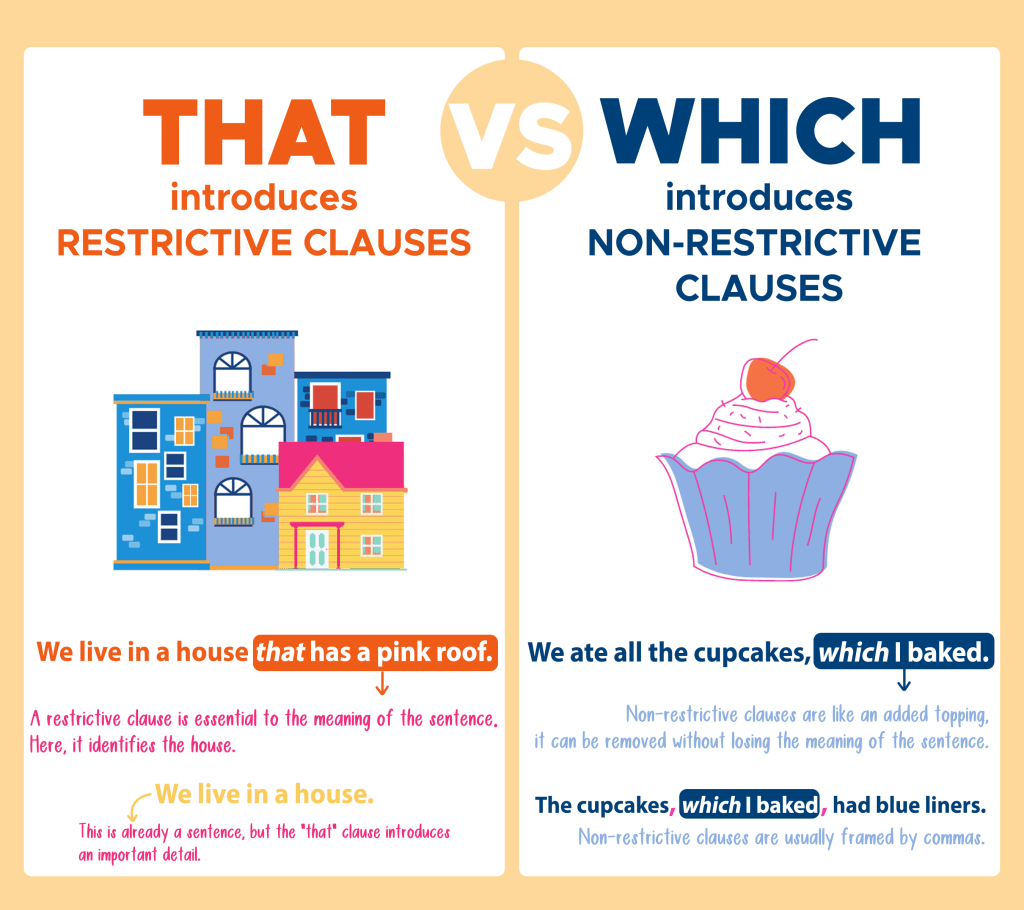
That:It is used to introduce restrictive clauses, which are also known as defining clauses. These clauses provide essential information about the noun they modify. They are not set off by commas.
Example: “The book that is on the table is mine.” (Here, the clause “that is on the table” defines which book is being referred to.)
Which:It is used to introduce non-restrictive clauses, also known as non-defining clauses. These clauses provide additional, non-essential information about the noun. They are set off by commas.
Example: “The book, which is on the table, is mine.” (Here, the clause “which is on the table” provides additional information about the book but doesn’t define it.)
Use in American vs. British English:
In American English, “that” is commonly used for both restrictive and non-restrictive clauses.
In British English, “which” is often preferred for non-restrictive clauses, while “that” is still used for restrictive clauses.
Preference and Clarity:
Some writers and style guides prefer the use of “which” for non-restrictive clauses to make sentences clearer and less ambiguous. However, this is a matter of style and can vary.
I am an experienced English Language trainer and teacher with a PG in English Language and Literature and a degree in English Education.
View more posts
 Verbal and Communication Skills Lab