What is Digital Body Language?

Digital body language encompasses the non-verbal cues and signals expressed through online communication channels. In face-to-face communication, body language includes facial expressions, gestures, posture, and other physical behaviors that convey emotions, intentions, and attitudes. In the digital realm, where these physical cues are absent, people use various elements to communicate effectively. Here are some components of digital body language:

  1. Emojis and Emoticons: Emojis and emoticons are graphical symbols used to convey emotions in digital communication. They add a layer of emotional expression to text-based messages, helping to clarify the intended tone.
  2. Punctuation and Formatting: The use of punctuation marks, such as exclamation points or ellipses, can impact the perceived tone of a message. Similarly, the formatting of text (e.g., bold, italics, underline) can be used to emphasize or de-emphasize certain words or phrases.
  3. Sentence Structure: The structure of sentences and the choice of words can convey nuances in digital communication. For example, using short, concise sentences may convey urgency or directness, while longer sentences might indicate a more thoughtful or detailed message.
  4. Capitalization: The use of uppercase letters can be employed for emphasis or to convey strong emotions. However, excessive use of capitalization may be interpreted as shouting and can alter the tone of the message.
  5. Response Time: The speed at which someone responds to a message can communicate various things. A quick response may signal attentiveness or eagerness, while a delayed response might suggest busyness or a need for more thoughtful consideration.
  6. Use of Humor: Humor in digital communication can be conveyed through jokes, memes, or witty remarks. Understanding the appropriateness and tone of humor is essential to avoid misunderstandings.
  7. Digital Etiquette: Proper digital etiquette involves using polite language, respecting others’ time, and being mindful of cultural differences. Following established norms for online behavior contributes to effective communication.
  8. Use of Images and GIFs: Sharing images, GIFs, or memes can add visual elements to digital communication, enhancing expression and making interactions more engaging.
  9. Online Presence and Profile Activity: Digital body language also includes the way individuals manage their online presence. This encompasses the content they share on social media, the frequency of updates, and the platforms they engage with.
  10. Virtual Meeting Behavior: In video conferences and virtual meetings, body language is expressed through facial expressions, gestures, and posture. Understanding how to present oneself professionally and attentively in these settings is crucial.

Understanding and interpreting digital body language is essential for effective online communication, as it helps individuals convey and interpret messages accurately in the absence of physical cues. It also contributes to building positive and respectful interactions in the digital space.
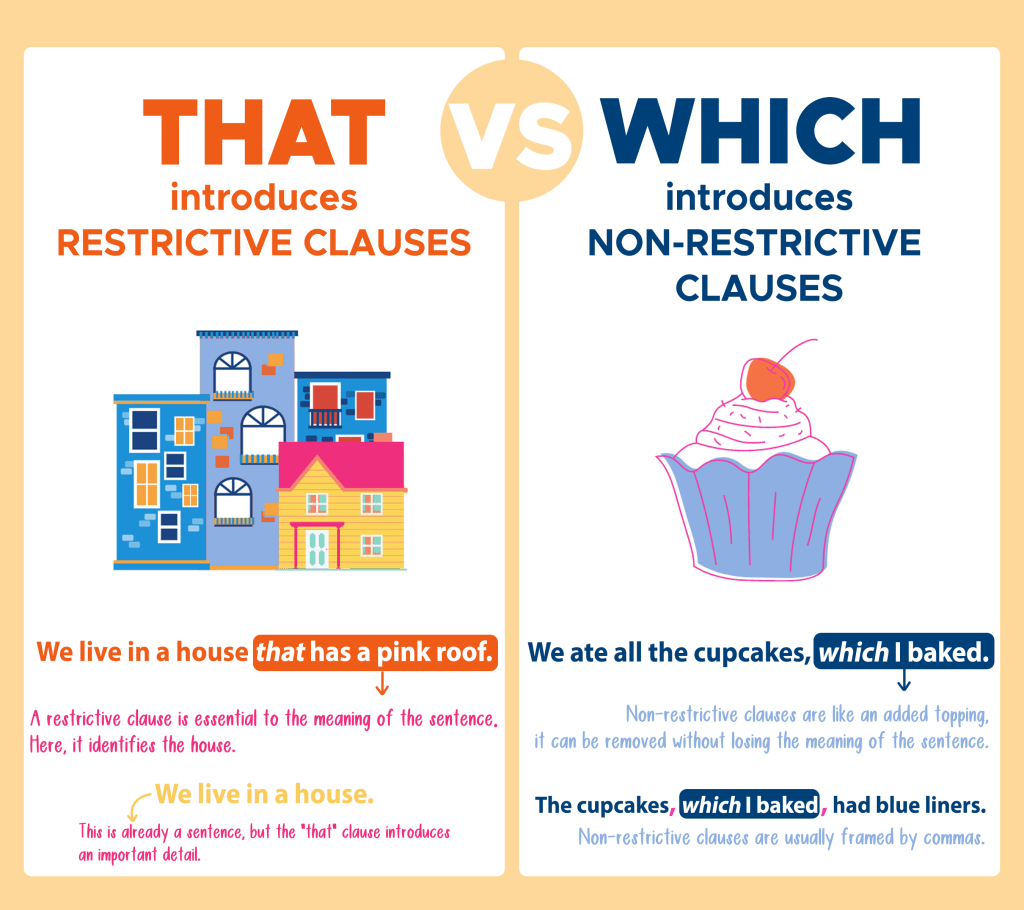
Difference Between “That” and “Which”

“That” and “which” are both relative pronouns that are used to introduce relative clauses in sentences.

  1. Restrictive Clauses (Defining Clauses):
    • That: It is used to introduce restrictive clauses, which are also known as defining clauses. These clauses provide essential information about the noun they modify. They are not set off by commas.
      • Example: “The book that is on the table is mine.” (Here, the clause “that is on the table” defines which book is being referred to.)
    • Which: It is used to introduce non-restrictive clauses, also known as non-defining clauses. These clauses provide additional, non-essential information about the noun. They are set off by commas.
      • Example: “The book, which is on the table, is mine.” (Here, the clause “which is on the table” provides additional information about the book but doesn’t define it.)
  2. Use in American vs. British English:
    • In American English, “that” is commonly used for both restrictive and non-restrictive clauses.
    • In British English, “which” is often preferred for non-restrictive clauses, while “that” is still used for restrictive clauses.
  3. Preference and Clarity:
    • Some writers and style guides prefer the use of “which” for non-restrictive clauses to make sentences clearer and less ambiguous. However, this is a matter of style and can vary.

How to create an impressive resume?

  1. Open ChatGPT and write the prompt “You are my Resume Creator”
  2. Go to LinkedIn and copy the job description of the company that you want to apply for
  3. Paste in ChatGPT along with some of the information about you
  4. Copy the resume created by ChatGPT and past it in instaresume.IO which will create a customized template
  5. Go to SkillSyncer website and upload your resume (This will provide the ATS score and will help you find out the keywords that your resume is missing)

Why is it important to have a rich vocabulary?

1. It Improves Reading Comprehension: Research has shown that kids need to understand 98% of the words they read to understand what they are reading. Improving vocabulary skills will improve their understanding of novels and textbooks.

2. Strong vocabulary allows you to develop other skills: The good news is that improving your vocabulary has a direct, positive impact on your capacity to build up your language proficiency as a whole. A leading linguist researcher Paul Nation notes: “Vocabulary is not an end in itself. A rich vocabulary makes the skills of listening, speaking, reading, and writing easier to perform.” (5) When your working memory is not loaded with hesitation about the correct spelling, pronunciation and contextual use of the words, you can concentrate fully on higher level aspects of language such as using precise sentence structures and appropriate expressions for the type of conversation that is going on.

3. Helps you to express better in writing: Having a good vocabulary to draw from can help you write more effectively. Students need to use a more formal tone when writing – not conversational language – and to do that, they need a richer vocabulary to tap into those words we don’t use when we speak.

4. Boost your power of persuasion: At work, in politics, in activism or in relationships it is crucial to be able to convince people. You want people to believe in you and support you. And one of the common methods that experts suggest to develop the skill of persuasion is to have a rich persuading vocabulary.

5. Professional Success: Researcher Johnson O’Connor found that “a person’s vocabulary level is the best single predictor of occupational success.”  Success in the business place depends on your communication skills.

References:

  1. Top 5 Reasons Why Vocabulary Matters
  2. Why is vocabulary acquisition so important?